

Chapter I
The Revolution
Tehran, 1979 — the moment a republic is improvised in the streets.
A cinematic investigation into power, history and the invisible architecture of nations.
To understand Iran today, one must understand the IRGC.

An analytical exploration of the Islamic Revolutionary Guard Corps and its transformation from a revolutionary militia into one of the most influential military-political structures in the Middle East.
Written as a long-form geopolitical essay, the work moves between archives, testimony and field reporting to map the institutional architecture that has, in four decades, reshaped the region.
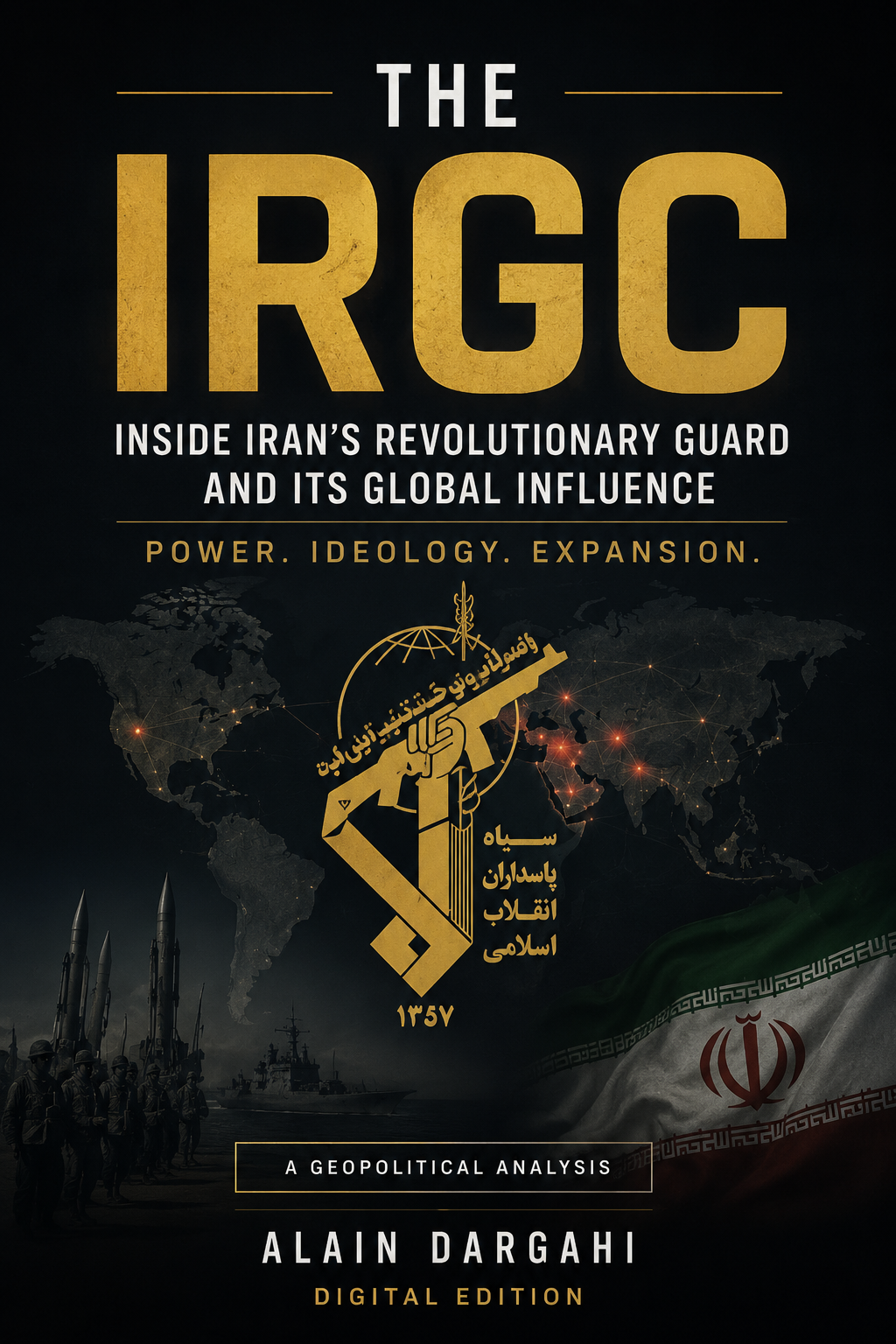
THE IRGC — The New Battle of the Persian Empire traces the rise of one of the most influential organizations of the modern Middle East, from the ashes of revolution to the silent corridors of global influence.
Part documentary, part historical essay, this work moves between archives, testimony and analysis to reveal the invisible architecture behind one of the defining geopolitical stories of our century.
Power survives through institutions.
The essay unfolds in six movements — from the revolutionary moment of 1979 to the institutional power of the present day.
1979. A monarchy collapses; a republic is improvised in the streets of Tehran.
A parallel army is created to guard the revolution from itself, and from the world.
Eight years of war with Iraq forge a generation, an ideology, and a doctrine.
From militia to ministry: the Corps embeds itself in the economy, the state, the silence.
Beirut, Damascus, Baghdad, Sana'a — influence written in alliances, not maps.
A geopolitical actor of global consequence, observed from the vantage of 2026.
Four cinematic fragments accompany the essay — slow, silent, observational. Each chapter opens with a moving image.
Tehran, 1979 — the moment a republic is improvised in the streets.
Faces, fragments, testimonies — a country recorded in whispers.
Behind the institution — corridors, uniforms, the architecture of authority.
Documents, maps, photographs — the historical record reassembled.
Revolutions do not end. They mutate.
The Imperial Army stands down. A new order is declared from the streets of Tehran.
Decree establishing the Sepāh-e Pāsdārān — the guardians of the new republic.
The Iran–Iraq war begins. A decade of attrition redefines the institution.
Hezbollah is organized in the Bekaa. The doctrine of forward defense takes shape.
The Corps reorganizes after the war: navy, aerospace, ground forces, intelligence.
From the Strait of Hormuz to the Levant — the IRGC operates as a state within a state.
Selected entries from a working archive — assembled from public records, press reports and field testimony.

An observer of international power structures — four decades spent inside the architecture of finance, law and statecraft.
Trained in political sciences and international law, his work moves quietly between archives, institutions and the men who shape them.
THE IRGC is the result of years of reading, listening and travelling — a long-form documentary essay on one of the defining geopolitical stories of our century.
A silent prologue — observed, not explained.
Understanding geopolitical power requires understanding the invisible structures behind nations, economies and conflicts.
A private, single-use download link to the PDF edition of THE IRGC — The New Battle of the Persian Empire. The link is generated only after PayPal confirms your payment on our server.
Yes. Payment is processed entirely on PayPal's infrastructure — we never see your card details. Your download is only unlocked after PayPal's API confirms the transaction is COMPLETED.
Each link expires after 10 minutes. This protects the file from being shared. If your link expires, contact us with your PayPal receipt and we will reissue one.
Yes — the PDF opens natively in Apple Books, Files, Preview and any modern PDF reader, on iOS, iPadOS and macOS.
This page sells the Digital Edition only. For collector or signed editions, please reach out directly.
As this is an instantly delivered digital good, all sales are final once the PDF has been downloaded.


